Monday, August 3, 2020

Newport, Martha's Vineyard and the Coming Storm

Vineyard Haven, Martha's Vineyard

I'm catching up on the past week's sailing as tropical storm Isaias approaches us while at anchor in Lagoon Pond on Martha's Vineyard.

Lisa's friends, Kellie and John took the ferry to meet us on Block Island last Sunday and they spent a couple days on the boat until we set sail for Newport on Tuesday. They arrived with two soft coolers and a duffel bag stuffed with food. Kellie, a professionally trained chef cooked some delicious meals.

The six hour passage from Block Island started off slow, but the wind built enough for a decent downwind sail into Newport Harbor. We had a bit of trouble furling the jib, first due to a wrap in the line on the furler drum and then when I sucked the spinnaker halyard into the furling sail, something I've never done before and don't recommend doing. John and I got things sorted out, but it required unwinding and rewinding the furling line three times, a tedious job when the jib is flying and you can't turn the furling drum and have to wind the 70 foot long line a dozen times through and around it.

Newport Harbor was really pleasant. We anchored just outside the mooring field in among dozens of other "freeloading" boats, a tight squeeze. Kellie and John departed on Wednesday morning and my sister Alison and nephew Griffin arrived in the afternoon for a brief visit. We took a dinghy tour of the harbor to look at the all the beautiful classic yachts and the ostentatious mega yachts. One of the largest, the 250-foot Bella Vita is available for charter for "only" $650,000 per week. These yachts look particularly immense, viewed from our tiny dinghy as we slowly motored by them right alongside, their gleaming hulls towering above us.

I spent the next couple of doing boat projects while Lisa went on a powerboat junket back to Block Island for a beach soccer party where she socially distanced making mudslingers with a gas-powered blender for the players. Lisa returned yesterday and Kellie and John re-joined Intermezzo to sail with us to Martha's Vineyard.

Yesterday's sailing was amazing, the best sailing day I've had for quite some time.  We beat upwind in 15 knot SSE winds until just off the end of Cuttyhunck Island, the westernmost of the Elizabeth Islands and then I tacked south and bashed through head seas under motor until I got to the layline to our destination, Vineyard Haven a tacked back over. The wind piped up to 20-25 knots we could ease our course northward a bit to get on a nice reach. I enjoyed three romping hours of sailing at boat speeds of 8-9 knots which is close to Intermezzo's hull speed. Towards the end the wind was blowing a solid 25 knots, so I gave John a lesson on how to tuck a second reef in the mainsail.

We arrived at Vineyard Haven on Martha's Vineyard around 20:00, too late for the drawbridge to open to let us into the lagoon so we anchored right off the causeway to the bridge for the night. The bridge opened up for us and I scooted through with great care, the bridge's horizontal clearance only 10 feet wider than Intermezzo's beam and a 20 knot crosswind blowing on us.

We dropped anchor and had a wet dinghy ride to shore to catch a bus for Oak Bluff to see the "gingerbread houses" there.  This community of around 300 small Victorian cottages was originally founded by Methodists in the 1800's who held religious retreats and meetings on the island.  It was nice strolling through the park-like neighborhood of tiny homes.

The tropical storm is forecast to hit here tomorrow afternoon and blow into the night with 25-30 knot winds and gusts up to 45 knots. My plan is to lie at anchor in the lagoon through the storm where we'll get the wind but no big waves. I'm confident in our ground tackle and the bottom holding conditions here, though 45 knots will be the biggest blow Intermezzo has ridden at anchor. I'm not worried about the anchor and rode, but will rig a second bridle as I think that is the weak link in the system. Hopefully we ride out the storm with no problems; it will be a good test of the ground tackle system I designed for exactly these conditions. 

Schooner at sunset in Newport Harbor

Newport street lamp

"Gingerbread Houses" of Oak Bluff, Martha's Vineyard

The park-like neighborhood of the "gingerbread houses"

Tropical storm Isaias on it's way

Saturday, July 25, 2020

Block Island

Block Island, RI

Intermezzo is anchored in the Great Salt Pond of Block Island. The scenery is beautiful, the weather variable and the clams delicious.

We departed Three Mile Harbor on the south fork of Long Island on Thursday morning. The weather forecast, which I have come to refer to as the “weather suggestion” was for 10-15 knot southwesterly winds and seas less than 1 meter, perfect for sailing to Block Island, just slightly north of due east.  Well, so much for the forecast…again. The winds were less than 10 knots and from the just slightly south of due west, direct downwind…again. Ugh.

I tried valiantly to sail, but the log has no less than 12 stops and starts of the engines. Here are extracts of the log entries:

10:38 Sailing downwind main and jib
11:37 Wind died
12:06 Sailing
12:09 The the wind died completely
12:40 …and then the wind is back
12:45 …and then there is no wind
13:54 Wind is back but f*ing dead downwind
14:01 Wind died…I GIVE UP!
14:26 Try again

Fortunately, the wind shifted south enough to make my last attempt successful and we enjoyed two-plus hours on a nice broad reach until we arrived at the inlet to the anchorage around 16:40.

The anchorage is crowded with boats, but we found a spot in shallow water on the eastern shore, just off a little point of land.  As we were finishing up anchoring, Scott and Donna from s/v Voyager, another Leopard 39 catamaran of the same vintage as Intermezzo motored up to us in their dinghy and invited us over to visit after dinner. We took them up on their invitation and enjoyed a glass of wine and friendly conversation with appropriate  “social distancing” outside on their afterdeck. Scott and Donna live in Rhode Island and keep Voyager on a mooring here in the summer and then sail down to Florida for the winter. We shared stories about passages and harbors along the US east coast.

Also in the harbor with us s/v Delos, of YouTube fame. This Amel Super Maramu ketch left Seattle WA over ten years ago, has been regularly posting videos on YouTube ever since and now has over 560,000 subscribers. Crew members, mostly attractive young people, came and went as the boat sailed around the world. Now it’s just the captain, Brian, his wife Kazza and their baby daughter, Sierra (aka Nugget) on board as they shelter from the COVID pandemic. We invited them over for dinner but they politely declined, opting to “lay low” socially for the time being.

I started binge watching the Delos videos about a year before I set sail from San Francisco in 2015 and they provided a lot of ideas and inspiration for my own sailing voyage. Brian is a solid captain and does all the repairs and improvement on the boat, which I relate to and respect.

Yesterday we biked around the southern portion of Block Island, which comprises about two thirds of the islands land mass. This island reminds me a lot of the English countryside with stone walls dividing landholdings dotted with country homes. It’s really picturesque, with glimpses of the sea from various vantage points as you ride along, lighthouses, several large freshwater ponds and lots of green open space.

After the bike ride we took the dingy to the low tide shallows and I dug for clams. A cold front was passing through and it was a bit chilly treading around in waist deep water and downright cold when I had to immerse my upper body to reach down and pick up my mollusk treasure pieces. I was happy getting a couple of dozen clams in about an hour of determined effort and Lisa turned them into a simple but delicious dinner.

Today I stayed on the boat to knock off some of the items on the “to do” list. I repaired the barbecue, replacing the burner, burner plat and propane valve which had corroded to become nonfunctional after over four years at sea. I also spliced the ends of the new Code 0 furler line. The splicing was time-consuming, as I had to re-learn how to splice double-braided line but the process and end result were very satisfying.

Tomorrow we have guests from Providence arriving.
Great Salt Pond anchorage

s/v Delos of YouTube fame

The Narragansett in New Harbor

Block Island landscape

Steps down to the sea

Great Salt Pond sunset

Tuesday, July 21, 2020

Coecles, Sag and Three Mile Harbors

We wound up our time exploring Shelter Island at Coecles Harbor on the west side of the island. It is a large, sheltered harbor and we anchored right off the shore of the Nature Conservancy's Mashomack Preserve. We ventured into the preserve by docking the dinghy on Taylor's Island and wading across a sandbar onto the main island. We would have had a really nice hike had it not been for swarming gnats that surrounded our heads most of the the time. It was still a good hike, it just took quite a bit of discipline to not be driven to annoyance by the tiny critters.

From Coecles Harbor we motored the short distance south across the bay to Sag Harbor. We anchored ouside the breakwater in the company of several megayachts. We went ashore to walk around town, have lunch and top up our fresh fruit and vegetables. Sag Harbor is a nice enough town, but there is a lot of vehicle traffic on the main streets, noisy and distracting. We had a nice lunch and picked up our groceries but didn't linger. Instead, after dropping of the food, we took the dinghy to a beach a few hundred yard from the boat. While wading out to go swimming, I dug around the bottom with my feet to see if there were any clams and immediately felt a big chowder clam. We spent the next hour treading in the shallows and came up with a dozen biggies. I made a clam stew, a very thick clam chowder with vegetables and big chunks of chewy clams. It was pretty tasty.

We left Sag Harbor this morning and continued eastward along the south fork to Three Mile Island, near the town of East Hampton. This is a large really beautiful harbor accessed from the bay via narrow inlet. It looks more like a freshwater lake than a saltwater harbor. There are relatively few boats in the anchorage and no megayachts at all. Very much more my style.

I'm looking at the weather for our upcoming passage to Block Island. I was not planning to depart until Saturday, but it looks like Thursday will have much more favorable winds, although it is forecast to be cloudy. So now the plan is to enjoy another day here and then set sail for Block Island on Thursday evening.

I was thinking to myself how ideal being on a boat is in these days of COVID. We have very little contact with other people but rather than being stuck in the same place indoors at home, we are outdoors and the boat moves freely from place to place. We really only come in contact with other people when shopping and we observe all the social distancing, mask wearing and hand washing recommendations. I didn't realize how good a situation this would be, more worried about what would happen if I or a crew member got sick. That seems almost impossible if we continue on as we have been.

Marshland along Coecles Harbor, Shelter Island

View along our gnat-challenged hike in the Mashomack Preserve

Classic wooden-masted schooner in outer Sag Harbor

Sag Harbor sunset


Friday, July 17, 2020

Shelter Island

West Neck Bay

We spent a pleasant two day anchored in Pipes Cove and visiting the town of Greenport, including a daily stop a the local brewery. This morning we weighed anchor and motored about halfway around Shelter Island and headed up into tiny West Neck Bay.

While anchored in Pipes Cove, I noticed an oyster boat pulling up racks of oysters that were being farmed in the water around us. I dinghied over and asked if I could buy some oysters and about a half hour later, 44 Oysterpond oysters were delivered to Intermezzo. They were a small but tasty and we ate them all up.

It was grey, windy and chilly when we set out this morning, but fortunately not raining. We motored south through Shelter Island Sound and then turned east in Noyak Bay to find the narrow entrance into West Neck Harbor.

There were quite a few boats anchored in the harbor, but we continued up a winding shallow channel to get to West Neck Bay. I was doing fine keeping Intermezzo in navigable depths until I misread the chart and gently touched the muddy bottom on a bend. I quickly reversed engines and got off the mud, chose another route and had no problem after that getting to the anchorage.

West Neck Bay is more like a small lake, almost circular, about a quarter mile wide. It's fringed by very nice waterfront homes, many with private docks. There is a public launching ramp nearby which we used to beach the dinghy. I went for a run, Lisa took the Montague bike on a tour of the island.

We collected a few mussels on the way back to try out back on the boat. I steamed them and then sautéed in a little butter. I was a but skeptical, as I've never seen this type of mussel served at a restaurant or in a fish market before, but they tasted pretty good. Providing we don't get sick overnight from them, we'll collect some more for tomorrow's dinner.

The weather started clearing this evening and it's very peaceful and calm tonight. Tomorrow is supposed to be sunny, good for our next stop, Coecles Harbor, on the other side of the island.

Old boatyard buildings in Greenport

Sunflowers along a Greenport sidewalk


Oysterpond oysters right out of the waters of Pipes Cove


Intermezzo's position shown by the red arrow in West Neck Bay
Intermezzo at anchor in West Neck Bay on a cloudy grey day


Thursday, July 16, 2020

Beginning of a New Voyage (Prequel)

This post is a chronicle of what it took to get Intermezzo underway on a new voyage after launching on June 27.

The first thing on the list after launching was to commission the electric head (marine toilet) in the master suite, one of the few luxuries I allow myself on the boat. Water had intruded through a shaft seal into the pump motor. I had the old pump motor rebuilt in Santa Rosa, but chose to purchase and install a complete new pump assembly so that I would have a spare. I got everything hooked up and did a test flush. The new pump and motor is so much quieter than the old- the water intrusion had really messed up the bearings in the old motor and made them noisy. I was so happy. Then, two days later, I was dismayed that the joker valves had failed and waste was slowly seeping back into the bowl after flushing. I dismantled everything again to install new joker valves and we were finally back in business.

I am motivated to provide the above information for two reasons. First, so that landlubbers understand that sailing and living on a boat is not paradise 100% of the time, as advertisements might have you believe. Second, it serves as the obligatory marine toilet story for those readers that do have boats and expect such tales of woe. No sailing blog is complete without an episode of a clogged or otherwise problematic head every so often.

After getting the toilet back in service, I moved on to a science project. My Lifeline AGM batteries did not seem to have the capacity they once had. At the end of last year's voyage, low voltage alarms were going off in the middle of the night, requiring me to get up and run the engines to recharge the batteries. I did some research and learned that these batteries can be reconditioned to recover their charging capacity. I figured it was worth seeing if I could do this before buying new ones.

The steps in involved in reconditioning the batteries are to fully charge them and then apply a constant 15.5 volts for eight hours. Before I did this, I wanted to test the batteries to know their capacity prior to reconditioning and then afterwards I could test them to measure any improvement.

I purchased two pieces of equipment for this experiment. I bought a Kunkin KP184 battery load tester for testing the batteries and a BK Precision 1688B DC power supply to condition them. These set me back about $320, a modest investment compared to the $2,000 price for new batteries. Both would be useful in on the boat in the future, regardless of the outcome of the experiment.

I disconnected one of the batteries from the boat and applied a constant 25 amp load with the Kunkin tester. The specified capacity of a new battery is 390 minutes under this load to get to a 100% discharged voltage of 10.5V. The battery actually lasted only 130 minutes under this load, only 33% of its rated capacity. I tested a second battery the same way and got the same capacity measurement. These were not promising results as I understand that the batteries need to have at least 50% of their rated capacity to be reconditioned.

I tried reconditioning a battery anyway, fully recharging it and then applying the 15.5V constant voltage with the BK power supply. The battery accepted very little charge, 2.4 amps or less during the conditioning. I then tested the reconditioned battery with the 25A constant current load and the result was no difference, only 33% of capacity.

So, I bit the bullet and purchased three new Lifeline 4DL batteries for $1910 with shipping and swapped out the old ones, which required the manhandling of 840 lbs of batteries on and off the boat. Oh well.  At least now I can use the BK power supply periodically to condition the new batteries and extend their lives.

The other big job that needed to be done at the dock was to seal the source of a leak. While bashing in heavy weather to the Panama Canal last April I noticed a lot of water dripping off of and into the food locker in the starboard hull. I tried to track down the source of the leak, but couldn't figure it out. I suspected it was coming from behind the rubrail on the side of the boat. It was.

The boat is basically constructed in two major pieces- the hulls and the deck. The deck is lowered on to the hulls and the two pieces joined with epoxy. The rubrail covers this joint. When I removed the rubrail, I discovered that there we some gaps in this epoxy joint and some unfilled screw holes that could let water in if it was determined to do so, like in Panama.

It was a relatively easy repair to make, but took time. I removed the stainless steel strips that hold the rubrail in place and then loosened sections of the rubber rubrail to expose the hull-deck joint. I cleaned out the joint and then caulked it with a high-quality sealant. Then, after polishing them, I replaced the stainless steel strips and put a thin bead of caulk along the top edge of the rubrail. I turned the boat around so that I could access the port side and did the same repair on that side for good measure. I'm confident I won't have a leak from the rubrails again.

The leak now fixed, I moved on to rebuilding the head of one of the watermaker pumps. The pump was not pumping at the same rate as its twin and was sucking air. I had to remove the whole pump assembly to access the pump head, but other than that, it was pretty easy to replace the old head with a new one.

It was time for sea trial, so I invited my Dad out for the first sail of 2020. It was fitting, as he was crew for the last sail of 2019. We motored out the inlet and tootled around for an hour, enjoying the water, conversation and a beer. When I ran the starboard engine hard, however, I saw quite a bit of white "smoke" (steam) coming out of the exhaust. Not good. Add another item on the list.

I had noticed the white smoke a couple times on our way to Mattituck last year, but I rarely run the engines hard so I didn't do anything about it. I guess I was wishing it would go away on its own, hahah. Yet deep down, I knew the truth. When I replaced the raw water pump impeller, one of its blades was missing. These blades don't just disappear into thin air. They lodge at the inlet of the heat exchanger and then compromise the engine's cooling system.

It's not hard to remove the cap of the heat exchanger to extract the piece of blade. The annoying and time-consuming part of the job is having to remove the alternator to get to the cap and then re-install it. Two hours of disassembly and reassembly for a ten minute repair. I got the little bugger out and no more white smoke. Good.

Everything on the list was pretty much done in time for Lisa's arrival last Saturday. I picked her up at JFK and now had helping hands. She deep cleaned the cabin and was a big help with the final pre-departure punch list. And now I have someone other than myself to talk to, though I still am talking to myself, which confuses and annoys her.

On Sunday we went shopping for provisions and on Monday it was time to return the rental car. That turned out to be kind of fun.

I had purchased a Montague folding bike to use for shoreside transportation. I put the folded bike into the trunk of the rental car and drove the 50 minutes to Bohemia to the car rental office. The car returned, I took the bike out of the trunk, unfolded it and rode the three miles to the Ronkokoma LIRR station, folded it again and boarded a train for the hour ride back to Mattituck. Hopped of the train in Mattituck, unfolded the bike and road the 2 1/2 miles back to Strong's. The bike is really well put together and rides great! A fun way to travel. A great addition to the boat's infrastructure.

And that was it. We were ready to go. And so we went.

Performing a capacity test on an old battery. It failed.

The leaking deck-hull joint exposed

The joint after caulking with sealant

Test sail with my Dad

The heat exchanger cap with the offending impeller blade lodged inside it

My folding Montague bike, a new way to get around on land


Wednesday, July 15, 2020

Beginning of a New Voyage

Greenport, NY

Yesterday afternoon I said goodbye to Strong's Yacht Center and Mattituck Inlet and we set sail to round Orient Point, enter Gardiners Bay and anchor outside the town of Greenport. With me is Lisa, able-bodied crew who sailed on Intermezzo from Isla Mujeres to New Bern, NC last summer. She arrived a few days ago, braving travel in these days of COVID to help me sail Intermezzo on this new voyage.

I'm going to write this post in two parts. This first part will cover the start of the trip, the second will be a prequel, a more technical post filling in the two-plus weeks time between launching the boat and our departure.

We got up early yesterday to attack a pre-departure checklist which included stowing tools and other boat work items, washing down the decks and settling my account at Strong's. As I walked back through the boatyard from the office after paying my bill, I felt a little sad to be leaving. I had spent over a month on the dock here at the end of last summer and almost a month this time. I made friends with the boatyard  workers, watched ospreys raise their young, got in tune with daily turning of the tides, went for runs along nearby country roads and enjoyed the solitude of having the place to myself evenings and nights.

One of my favorite prompts for contemplative meditation is "the last time". There will be moments in everyone's life when it is the last time for being somewhere, seeing someone, experiencing something. Maybe it isn't the last time, but maybe it is. When I pause to consider this when I am doing something, it often makes my experience much more poignant and meaningful and I often feel more appreciative and grateful. So, as I walked back through Strong's to the boat, I considered that it might be the last time I am ever in this place again. And I felt so grateful for having found such a beautiful, friendly and supportive spot for Intermezzo to spend the past 10 months.

My bittersweet feelings of farewell gave way to excitement of beginning a new trip as we slipped the dock lines and headed out Mattituck Inlet into the Long Island Sound. The wind was blowing gently from the west as we turned east towards Orient Point, putting us on a dead downwind point of sail. I put the main and jib wing-on-wing and we glided along at almost four knots. The weather was cool, mostly sunny, with the line of a cold front off in the distance to the northeast.

About halfway to Orient, the wind suddenly shifted almost 180 degrees to come right at us, right on the nose. The story of my sailing life. And just for fun, we had a 1.5 knot foul current flowing against us. So, I switched on the engines and motored until I could make the turn south to round Orient Point Light and head into Gardiners Bay. Though I half expected the wind would shift to be against me again, it took pity on me and didn't. We enjoyed a nice reach with light easterly winds all the way to the anchorage as the sun set and a thunderstorm was building ahead of us.

I figure it might be helpul to provide a little geographic orientation for those not familiar with the Long Island waters we're in. Long Island sticks out into the Atlantic to about 100 nm east of New York City. About two thirds of the way out, it splits into two forks, like a fish's tail. The end of the north fork is Orient Point, the end of the south fork is Montauk Point.  Between these two forks are Gardiners and the two Peconic Bays, Little and Great. That's where we're going to be sailing for the next week or so. Yesterday, we sailed from the outside of the north fork, around it's tip and then along the inside, the south shore of the north fork. Between us and the north shore of the south fork is Shelter Island. We'll be heading there soon.

Last evening we dropped anchor in Pipes Cove, just west of the historic town and harbor of Greenport. I enjoyed my first rum sundowner followed by a nice dinner of braised cod over sautéed vegetables.  The thunderstorm never got on top of us, but it did drop some heavy rain for a while. The cold fronts passing through right now really chill things down, highs in the low 70's and low's in the 60's. Lisa, a warm weather sailor, is suffering and complaining. I'm enjoying the free air conditioning, knowing how hot and humid it can be here.

It felt so good yesterday to be sailing again. I know this boat as well as I know my own body and I love being reconnected with the wind, water, weather and the marine environment. I sometimes wonder when I might give up this nomadic lifestyle for something more stable and grounded. I'm reminded that it's not time for that, yet. It's time to continue loving my life on the water.

Toasting the beginning of a new voyage with a Montauk Summer Ale

Rounding Orient Point Light, the Orient Point - New London ferry in the background

Pipes Cove anchorage, Greenport to the left, Shelter Island to the right


Sunday, June 28, 2020

Return to Intermezzo

Intermezzo floats again!

I'm back on Intermezzo at Strong's Yacht Center in Mattituck, NY. I arrived a week and a half ago and set to work preparing the boat for launch after being stored on the hard since September. Now we're in the water and once all systems brought up to seaworthy condition, my plan is for a leisurely cruise up to Maine for the summer and then head south in the fall. A new voyage.

I had originally planned on returning to Intermezzoin late April but a pandemic happened. I waited until COVID-19 infections in Suffolk County had significantly declined and there was plenty of hospital capacity. I considered the risks of traveling and decided that it was reasonably safe if I took appropriate precautions. I really wanted to get the boat opened up after sitting all winter under shrinkwrap. So, I booked a flight, packed my bags, said goodbye to land life and boarded a plan last Wednesday morning.

The airport was eerily empty and my flight was uneventful. I had a full row of seats to myself and the other passengers and crew seemed to be taking precautions seriously. Wearing a N95 mask for over six hours straight was pretty uncomfortable and I gained greater appreciation for health care workers who have to wear masks plus more PPE for much longer periods. I landed at JFK around 6 pm and picked up my rental car, wiping down the steering wheel, controls, handles and seat with disinfectant wipes. It felt more like I was undergoing a medical procedure than traveling.

I drove out to Mattituck, stopping for a take-out dinner along the way and arriving at the boat around 8:30 pm. The boat was dirty on the outside, but amazingly clean inside. Strong's staff was kind enough to hang a half dozen DampRid bags around the boat and they seemed to have really helped keep the boat fresh and free from any mold. Quite a big improvement compared to opening up the boat after storage over a tropical summer in Costa Rica and having to deal with a major mold remediation project.

I spent my first day back exchanging my airport rental car for a cheaper local agency one, going grocery shopping and washing the exterior of the boat. The next day I flushed out the non-toxic antifreeze in the domestic water system, which took longer than it should have. I had to track down a blockage in the hot water piping on the port hull which turned out to be caused by sediment from the water heater lodging in a sink fixture.

To get the boat ready for launch I had to fix the propellers, repair damage to both bows, paint the sail drives, paint the bottom, and swap the anchor chain end-for-end.

One of the Gori propellers was not folding and unfolding properly. It turned out to be a slighly bent blade. I took it to Bossler & Swezey, a propeller shop in Bellport. At first they refused to work on it, telling me that they didn't do folding propellers. I looked at them with surprise and disbelief, like a patient who goes to the emergency room and is denied treatment. I protested, saying something about the law of the sea and offering assistance to a mariner in distress. They relented and took in my injured propeller but with the agreement that I wouldn't hold them responsible if they damaged it further. They ended up dong great work for a very reasonable price and returned the prop as good as new, polished to a beautiful golden shine.

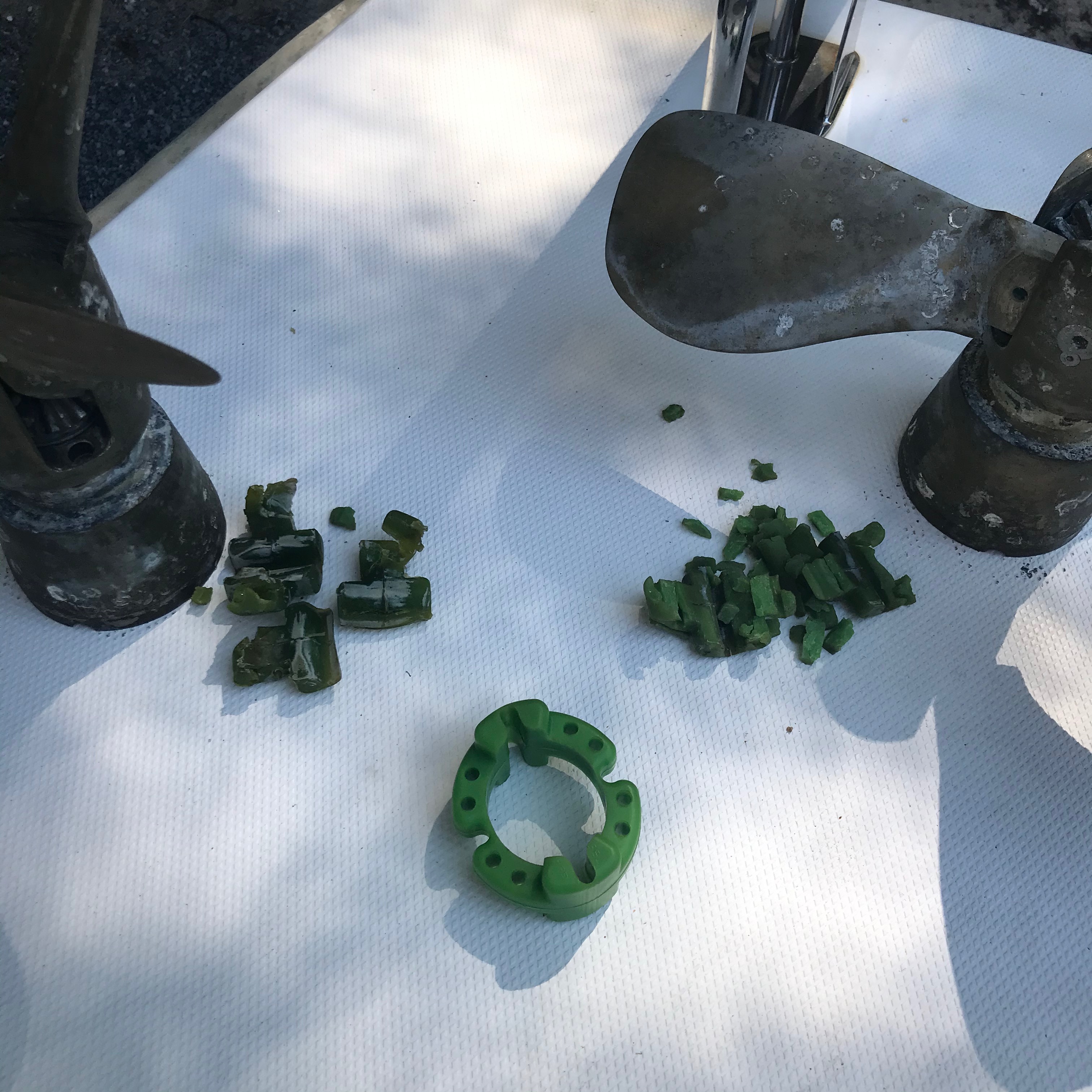
When I took the prop off for the repair, I discovered that the flexible hub bushing had disintegrated into little pieces of rubber. This bushing is like a cushion between the prop and shaft, protecting both from damage due to impact. I figure I must have hit something or wrapped a line so badly that the bushing broke and then ground itself apart over many, many miles of motoring. Fortunately the propeller still works without this bushing and the granulated rubber packed itself tightly inside the hub, effectively reforming itself and providing some protection.

Not so with the other prop. The hub bushing broke into four large pieces and the propeller was wiggling around on the shaft, functional but not good for the prop or the sail drive. These bushings are easy to replace but, boy, are they expensive. They are a just a bit of molded rubber, about the size of mini-donut, but cost $160 each! Replacing these plus the three tiny rubber flexible stops that cushion the blade when it opens set me back almost $400 for the two propellers. Ouch.

Both bows of the boat had been damaged by the anchor chain dragging against them a few times while being raised in challenging conditions. The gelcoat was chipped and cracked, deep enough in some places to expose the fiberglass laminate. I ground down the ships, routed out the cracks and filled them with epoxy. I faired the repairs, applied a coat of resin to smooth them out and then finished with three coats of Interlux Interprotect epoxy barrier rather than gelcoat. Better than new.

The one mistake I made when repairing the bow had nothing to do with the work, but rather, my food. I was very clever and extended the pot life of the very expensive epoxy barrier coat by putting my paint container in the freezer between coats. Well, it turns out the fumes from this paint are heavier than air and sunk from the freezer into the refrigerator where they enveloped all my food. It also turns out that cheese and chocolate absorb these fumes, maybe something to do with fat content. As do plastic surfaces and containers. I had to throw out all my cheese and my beloved chocolate cookies as they tasted truly terrible and were probably not very healthy to ingest.  Even after wiping out the whole fridge and washing all the containers, it still smelled faintly of paint for a couple of days.

Painting the sail drives was pretty easy, though this time I applied three coats of Interlux Primocon epoxy primer prior to the aluminum-compatible anti-fouling Trilux 33 finish coat. My experience has been that the Trilux goes away pretty quickly and I want something to continue protecting the aluminum sail drives from corrosion after the finish coat was worn away.

Painting the bottom was really easy for me because I had the yard do it. Two coats of black Petit Hydrocoat with an extra coat at the bows, leading edges of the keels and the rudders where the ablative paint wears away more quickly. My last bottom job was in March 2017, applied in Puerto Chiapas, Mexico and it held up really well. The paint came from Comex and I don't want to know what was in it that made it last so long. I hope the Hydrocoat does as well.

I dropped the anchor chain onto the pavement and laid it out to inspect it and remark it for length. That 300 feet of 3/8 inch chain is heavy to move around, especially in the blazing sun! It was a more strenuous and tiring job than I thought it would be. About half the galvanizing along about half the chain's length has worn off over the past six years of use. By swapping the chain ends, the half with nearly new galvanizing is now the working portion of the chain.

Just before launching I looked over the engines carefully, checked the oil and coolant levels, and bolted down the covers of the raw water pumps that I had left cracked open during storage, a lesson learned from past pump failures. Then I stuck the raw water intake hose into a bucket of water and ran each engine for a few minutes to make sure all was good. Both engines started right away and ran smoothly.

Saturday morning, Intermezzo was hoisted up on the Travelift and lowered gently into Mattituck Inlet waters. I'm back on the same dock that I was last summer, enjoying watching geese, swans, ducks and other waterfowl and my favorites, the ospreys. When I left here last September, the ospreys had taught their young to fish and fly and were departing for their winter homes. Now I'm watching them tending to their nests, not sure if they have eggs or chicks in them, nature's cycle continuing on.

I have about another week and a half of work to do to finish up projects that are best done at the dock. Then I'm going to head into the waters between the two forks  at the end of Long Island, Gardiners, Little Peconic and Great Peconic Bays. Before that, I might venture across the sound to Old Saybrook to visit my sister and family in Connecticut for a couple of days.  We'll see how things go.

It feels good to be back on board my floating home.

Returning to Intermezzo waiting on the hard


Two old, one new flexible hub bushings for propellers


Bow damage


Intermezzo back in the water on Mattituck Inlet