I just returned to Intermezzo after a professionally productive but personally tumultuous month on land. I was welcomed aboard by Roy, who has been dutifully looking after the boat, and Alex, who runs day charters for tourists on his nearby trimaran Mas Tequila. Alex came bearing cold cervezas, very welcome after 11 hours of traveling.
Intermezzo is in good shape. Roy had to battle an invasion of biscuit beetles for two weeks, but they seem to be all gone now. I brought with me lots of Racor fuel filters, a filet knife, a sharpening stone, fishing lures, caulk to reseal the forward portlights, some food “delicacies” from Costco, a fancy new aerator for the galley sink, and sundry other items. Unpacking my suitcase was like opening Christmas presents for the boat. Roy seemed quite excited by it all. (Perhaps he’s been alone for a bit too long.)
The weather here is sunny and warm, quite a change from the chilly, rainy, damp weather of Northern California. I’m glad to be back in shorts and out of shoes.
I think we’ll leave the marina tomorrow afternoon after topping off the diesel tanks and anchor out in Bahia Zihuatanejo. We need to replace the prop zincs and scrub the bottom before setting sail and it will be nice to be able to swim off the back of the boat again. Their are saltwater crocodiles here in the marina and lots of signs prohibiting swimming and feeding them, which would appear to be potentially two related activities.
Tuesday, February 26, 2019
Wednesday, January 30, 2019
Intermezzo’s Top 20 Gear List - Part 2
This is Part 2 of Intermezzo’s Top 20 Gear List, covering the top 10 of the Top 20 items in countdown order. Part 1 covered items 20 through 11 in likewise fashion.
 Our Iridium Go! satellite communication device keeps us connected while at sea and we use it with the PredictWind Offshore app for weather forecasts and routing. The Go! turns our smartphones into satellite phones for voice calling, texting and email. There’s an SOS button to press that alerts a global search and rescue service if we get into big trouble. Reception is pretty good, voice call quality okay, text messaging excellent, and email basic, but reliable. PredictWind weather and wind forecasts have been reasonably accurate and the weather routing good for big picture purposes. PredictWind now offers Iridium voice and data packages with inexpensive SIM cards that let us reduce costs by activating and deactivating service to based on Intermezzo’s sailing schedule. The Go! is easy to install, set up and use and has been a reliable means of communication while offshore. Customer support at PredictWind has been outstanding.


 Intermezzo's dinghy and outboard serve as main means of transportation between shore and the boat when anchored out. It's our dive boat and our fast water excursion vehicle, too. The Achilles HB-315 rigid hull inflatable boat (RIB) is well-made, stable, gets up on a plane easily and can carry four adults with gear. Its hypalon tubes still look great (it helps that it is shaded by the solar panels when raised on its davits) and the fiberglass hull is in pretty good shape after being hauled up many sandy beaches (less wear now with dingy wheels, #19 on list). Our Yamaha 15 hp four-stroke outboard is a big, heavy beast compared to a two-stroke motor, but performs well and has never let us down. Amazingly, it has started on the first pull 90% of the time, even after long periods of storage, despite me not having done any maintenance whatsoever in over three years since it was purchased. I'm not proud of my neglect, but I am impressed with the engine! The Yamaha gets the dinghy up on a plane with four adults on board and makes the boat fly at nearly 20 knots with only two aboard. The dinghy rows decently, too.
 When we began our most recent passage from La Paz, my crew, Pete and Roy, had never sailed under a Code 0 gennaker sail before. I told them that I loved Intermezzo's Code 0 and bet they would, too. Sure enough, as we ended our journey in Ixtapa, Pete told me that one of the best aspects of sailing on Intermezzo was the Code 0 sail. "I love that sail", he said, and Roy shook his head in agreement. Intermezzo's Code 0 was designed by Dave Calvert (Calvert Sails), a specialist in sails for multihulls. It is an amazing sail. Dave was great to work with and produced a great sail at a great price. Intermezzo's Code 0 works a apparent wind angles ranging from 65 degrees to dead downwind and apparent wind speeds of 5 to 20 knots. It trims nicely with the main at wind angles less than 125 degrees, but really likes to fly on its own at deeper angles, especially in light airs. I can't tell you enough how peaceful and easy it is sailing downwind on just the Code 0, especially at night (I write repeatedly about it in this blog!). The sail is easy to deploy and douse singlehanded with its continuous line furler by Colligo Marine, another great vendor of innovative rigging products. I love this sail!
 I figure that the sun provides about 80 percent of the electricity needed to live comfortably on board Intermezzo. When it's really sunny and we aren't sailing at night, we can live on 100% solar. We never have to run the diesel engines just to charge batteries and only have to use the portable gas generator if it's cloudy for a few days. It's great not to burn smelly and polluting fossil fuel and not have to listen to a running engine. Intermezzo's main solar panels are two Kyocera 270 watt fixed panels mounted on stainless steel supports cantilevered off the hardtop. Each panel is connected to it's own MidNite Kid Solar MPPT charge controller. A separate charger allows charging for each panel to be optimized, especially important if one panel is partially shaded. A single charger can handle both panels if needed, providing a ready spare if one charger fails. Other than needing to reset a controller every once in a while, this system provides clean, quiet, reliable power without having to lift a finger.
10. Iridium Go! and PredictWind Offshore

9. Lifeline Batteries
I'm somewhat surprised that a gear as mundane as batteries made it this high on the list. But, then again, I'm not. This is my third boat with Lifeline Batteries and I can't overstate how good they are. They are well made, charge faster than most other lead-acid batteries, spill-proof, can take a beating, are maintenance free and last a long time. The batteries in Intermezzo's house bank are over six years old and are just now showing signs of not recharging to 100% of capacity. Fortunately, Lifeline batteries are hand built and can be equalized (conditioned) to regain lost capacity. I'm going to do that soon and I'll report on the results. I'm hoping I can squeeze a couple more years out of my beloved Lifelines before I make the big switch to lithium batteries, which are far better suited for sailboats, but quite expensive.
8. Victron Multiplus Compact Inverter/Charger

Another piece of boring electrical gear makes the Top 10 list. Intermezzo's Victron Multiplus Compact Inverter/Charger is truly multipurpose for us. It converts DC power to AC to power computers, tools, the NutriBullet (#17 on the list) and my espresso machine (another luxury item of self-indulgence). It allows our Yamaha portable generator (#14) to top off the batteries on cloudy days. And it lets us keep the batteries charged when we're plugged into shore power at a marina. It is indeed compact, fitting neatly in the cabinet below the galley sink (not where I would choose to locate electrical equipment, but Intermezzo's builders thought otherwise). One key feature of the Victron is that you can limit how much current it draws from an AC power source. This is how we can use such a small, lightweight portable generator without overloading it. Many more advanced features can be configured by software to get the most out of the boat's batteries and electrical system. Intermezzo's Multiplus was easy to install and set up and has performed flawlessly in the background.
7. Spectra Cape Horn Extreme Watermaker

A watermaker salesman once told me, "You don't buy a watermaker for drinking water. You buy it for your love life." I get it. A watermaker lets you and the crew take regular showers. Everybody is happier, refreshed and smells better. I installed Intermezzo's Spectra Cape Horn Extreme watermaker in the starboard bow compartment, forward of the master shower. It fit perfectly and is in an easy to access place where I don't have to worry about water leaks. Our watermaker puts out about 18 gph with both pumps running and about 10 gph on only one pump. Running with a single pump on sunny afternoons works great with our solar panels and we run two pumps when we are motoring or using the portable generator to top up the batteries. The Spectra has worked great and has required no repairs or maintenance, other than normal flushing, filter changes and "pickling" during storage. The watermaker not only makes fresh water when there is none, it also provides a safe source of drinking water when the quality of water at the dock is questionable, as is the case where we've cruised in Mexico and Central America.
6. Dual Raymarine e7 Multi-Function Displays

When I installed radar on Intermezzo, I decided to install a second multi-function display (MFD). What a great decision! The 7-inch screen on the Raymarine e7 MFD is pretty small, but I'm confident that having two smaller displays is better than having a single larger one. Not only does having a second MFD provide a ready spare for redundancy, it also provides very helpful ways for viewing navigational information. During daytime sailing, we typically have the upper MFD display the chart set to relatively short range (2.5 to 10 nm) to know what's immediately around us, and the lower MFD display the chart set at long range (10 to 50 nm) to see the big picture for our passage. At night, we switch the upper MFD to display radar and the lower MFD to show the chart. The top position for the radar not only makes it prominent for the helmsperson, the darker radar screen also helps preserve night vision. These MFDs, used in conjunction with our iPad with Navionic and Raymarine apps (#12 on the list), really makes safe piloting and navigation a breeze.
5. Achilles Dinghy/Yamaha Outboard
 Intermezzo's dinghy and outboard serve as main means of transportation between shore and the boat when anchored out. It's our dive boat and our fast water excursion vehicle, too. The Achilles HB-315 rigid hull inflatable boat (RIB) is well-made, stable, gets up on a plane easily and can carry four adults with gear. Its hypalon tubes still look great (it helps that it is shaded by the solar panels when raised on its davits) and the fiberglass hull is in pretty good shape after being hauled up many sandy beaches (less wear now with dingy wheels, #19 on list). Our Yamaha 15 hp four-stroke outboard is a big, heavy beast compared to a two-stroke motor, but performs well and has never let us down. Amazingly, it has started on the first pull 90% of the time, even after long periods of storage, despite me not having done any maintenance whatsoever in over three years since it was purchased. I'm not proud of my neglect, but I am impressed with the engine! The Yamaha gets the dinghy up on a plane with four adults on board and makes the boat fly at nearly 20 knots with only two aboard. The dinghy rows decently, too.
4. Code 0 Gennaker by Calvert Sails
 When we began our most recent passage from La Paz, my crew, Pete and Roy, had never sailed under a Code 0 gennaker sail before. I told them that I loved Intermezzo's Code 0 and bet they would, too. Sure enough, as we ended our journey in Ixtapa, Pete told me that one of the best aspects of sailing on Intermezzo was the Code 0 sail. "I love that sail", he said, and Roy shook his head in agreement. Intermezzo's Code 0 was designed by Dave Calvert (Calvert Sails), a specialist in sails for multihulls. It is an amazing sail. Dave was great to work with and produced a great sail at a great price. Intermezzo's Code 0 works a apparent wind angles ranging from 65 degrees to dead downwind and apparent wind speeds of 5 to 20 knots. It trims nicely with the main at wind angles less than 125 degrees, but really likes to fly on its own at deeper angles, especially in light airs. I can't tell you enough how peaceful and easy it is sailing downwind on just the Code 0, especially at night (I write repeatedly about it in this blog!). The sail is easy to deploy and douse singlehanded with its continuous line furler by Colligo Marine, another great vendor of innovative rigging products. I love this sail!
3. Solar Panels and Charge Controllers

 I figure that the sun provides about 80 percent of the electricity needed to live comfortably on board Intermezzo. When it's really sunny and we aren't sailing at night, we can live on 100% solar. We never have to run the diesel engines just to charge batteries and only have to use the portable gas generator if it's cloudy for a few days. It's great not to burn smelly and polluting fossil fuel and not have to listen to a running engine. Intermezzo's main solar panels are two Kyocera 270 watt fixed panels mounted on stainless steel supports cantilevered off the hardtop. Each panel is connected to it's own MidNite Kid Solar MPPT charge controller. A separate charger allows charging for each panel to be optimized, especially important if one panel is partially shaded. A single charger can handle both panels if needed, providing a ready spare if one charger fails. Other than needing to reset a controller every once in a while, this system provides clean, quiet, reliable power without having to lift a finger.
2. Raymarine Autopilot
Intermezzo's autopilot is amazing. It steers the boat better than I can. In heavy seas, I'll steer by hand for a while to get a feel for the boat, which takes a fair amount of concentration and effort. After 30 minutes, I've had enough and engage the autopilot. It's humbling to watch a fairly simple device steer a smoother course than me, it's sensors and computer algorithms quickly learning the motion of the sea and the boat's response. The autopilot also allows me to easily sail Intermezzo singlehanded, steering while I raise and lower the mainsail, furl and unfurl the headsails, tuck in or let out a reef, plot a position, watch a radar target, make lunch, open a beer...I can't imagine sailing Intermezzo long distances without it. It is both a vital piece of safety equipment and an appreciated luxury item. Wait a second...I can steer better than the autopilot...when sailing close-hauled upwind. Whew...glad to remember I'm not totally replaceable by a machine.

1. Rocna Anchor

And the No. 1 piece of gear on Intermezzo?
(Drum roll....)
(Drum roll....)
Our Rocna anchor!
It sets easily. It holds in storm conditions. It's never dragged. It lets me get a good night's sleep. It lets us leave Intermezzo "on the hook" for extended periods. I love this anchor, even more than the Code 0 sail. I selected the Rocna 33 (33kg/73lb) for Intermezzo, a size larger than indicated on Rocna's sizing chart (two sizes larger than for an equivalent length/weight monohull). I upgraded the anchor chain to 3/8" (10mm) G40 chain to match the anchor's strength. Yes, this all added quite a bit of weight, but it's offset by Intermezzo not having a generator or air conditioning and only having to keep the water tanks half full by having a watermaker. The anchor fits like a glove on the Intermezzo's anchor roller. After many a night anchored in high winds, bouncy seas, Intermezzo swinging around in big arcs, I never worry about the Rocna holding. I do keep a careful eye on the bridle and attachment points...I figure something on the boat will break before the anchor or chain lets go. This is the single best investment in gear for Intermezzo that I've made, without question.

Wednesday, January 23, 2019
Intermezzo's Top 20 Gear List - Part 1
In March 2013, shortly after taking delivery of my new Leopard 39 catamaran Intermezzo in Oakland, California, I posted to the Leopard Catamaran Owners Group on Yahoo! requesting "Boat Outfitting/Fitting Out Recommendations". This group is a great resource for Leopard cats and I received a lot of good advice from that post and took it into consideration when preparing the boat for our "Sailing Intermezzo" cruise.
Almost six years and over 10,000 nm later, we sat down and had some fun coming up with a Top 20 list of the gear we have on Intermezzo. This is the gear that we find most valuable to us, a subjective evaluation based on personal experience and preferences.
Here is Part 1 of Intermezzo's Top 20 Gear List, ten of the items on the list presented in reverse order of ranking, for a dramatic "countdown" effect:


 Our AccuRite wireless thermometer lets us know the current temperature of our refrigerator and freezer, the highest and lowest temperatures since the last reset and sounds an alarm if temperatures get too high. We put the wireless sensors in the warmest parts of the fridge and freezer (against the front of the drawers) so we know that average temperatures are lower than those displayed. The thermometer has allowed us to set the fridge thermostat to conserve energy, let us know when there was a problem with the fridge (loose tube connection let refrigerant escape) and when we've accidentally turned off the fridge a few times by bumping into its power switch. It's a good insurance policy against losing tasty food due to spoilage and having to live off canned crap.


Almost six years and over 10,000 nm later, we sat down and had some fun coming up with a Top 20 list of the gear we have on Intermezzo. This is the gear that we find most valuable to us, a subjective evaluation based on personal experience and preferences.
Here is Part 1 of Intermezzo's Top 20 Gear List, ten of the items on the list presented in reverse order of ranking, for a dramatic "countdown" effect:
20. Turkish Towels

We purchased a set of six Turkish towels from Amazon based on a recommendation in another sailor's blog (so sorry, I can't recall whose). They have been amazing...lightweight, fast drying, durable, colorful. We use them for the beach, to dry off after a stern shower, between skin and vinyl upholstery to eliminate that Post-it adhesive effect, and wear them as sarongs or shawls. We issue a towel to each person when they come on board and the different colors lets everyone keep track of whose towel is whose. At $48 for six towels with free shipping they are a great bargain. We've had them on board since June 2015 and they look almost new.
19. Dinghy Wheels

After a year of straining and struggling to haul our dinghy up onto beaches, I finally broke down and bought some dinghy wheels. I had held off doing so because I think they look stupid when not in use; wheels on the stern, pointing up in the air, ruining the dinghy's looks and confounding landlubbers. I'm glad I broke down and bought them. I purchased wheels from Danard Marine Products, the "Cadillac" of dinghy wheels, beautifully machined from aircraft grade aluminum alloy. Down in Panama we had 10 foot tides and shallow sloped beaches, which sometimes required hauling the dinghy hundreds of yards which would have been just about impossible without wheels. The wheels are easy to deploy and make landing and launching the dinghy safer and easier, especially in surf. On the way in, you just power in until the wheels touch bottom, shut off the engine, leap out and haul up onto the beach. On the way out, you wheel the dinghy into the water until the wheels just start lifting off the bottom, start the engine and drive away. In surf, timing is everything and you need to make absolutely sure the engine is off or in neutral whenever bodies or limbs are in the water. These wheels saved our backs and our dinghy's bottom. They were easy to install and are still as good as new.
18. Refrigerator/Freezer Thermometer

17. NutriBullet

Our NutriBullet blender lets us make healthy, cold, refreshing smoothies. It blends quickly so doesn't use much power and we usually want cold smoothies when its hot and the sun is shining bright and the solar panels are putting out big amps anyway. We typically load it up with frozen spinach, frozen fruit, soy milk and water and let it rip. It's a great way to eat fruit and vegetables while underway, especially after the fresh stuff has been consumed. The Captain has been known to commandeer the NutriBullet to make Margaritas and Piña Coladas, too.
16. Raritan Marine Elegance Electric Head

Okay, this is a luxury item, blatant self-indulgence. But when you live on a boat most of the time, pumping a manual head gets pretty old, pretty quickly. Intermezzo's Raritan electric head flushes with just the push of a button. Pure bliss. On a practical note, this head allows us to flush with a small amount of fresh water, eliminating the odors that come with saltwater flushing. The downsides: It's noisy. It doesn't work without electricity. You can't swallow olive pits (don't ask why). We kept the manual head in the other hull as a backup if power fails and to train guests in marine toilet operation. We typically flush that head with fresh water, too. I can't tell you how big a difference this makes in reducing odors and eliminating the need to beat head hoses to get rid of uric acid crystal build up. Our electric head has performed very well with minimal maintenance and Raritan has great customer service.
15. Mantus Dinghy Anchor

The Mantus dinghy anchor is like a miniature version of Intermezzo's amazing main Rocna anchor. It has incredible holding power in sand and when I've dropped it into crevices between rocks it's held well, too. I don' think I would enjoy snorkeling or diving from the dinghy without such a good anchor; I'd be afraid I'd surface and the dinghy would be goon. It's light, compact and stows easily in the dinghy's bow compartment. It's held up very well. The only change I'm going to make is to add a six foot length of galvanized chain to the rope rode to help prevent chafe on rocky bottoms.
14. Yamaha Portable Generator
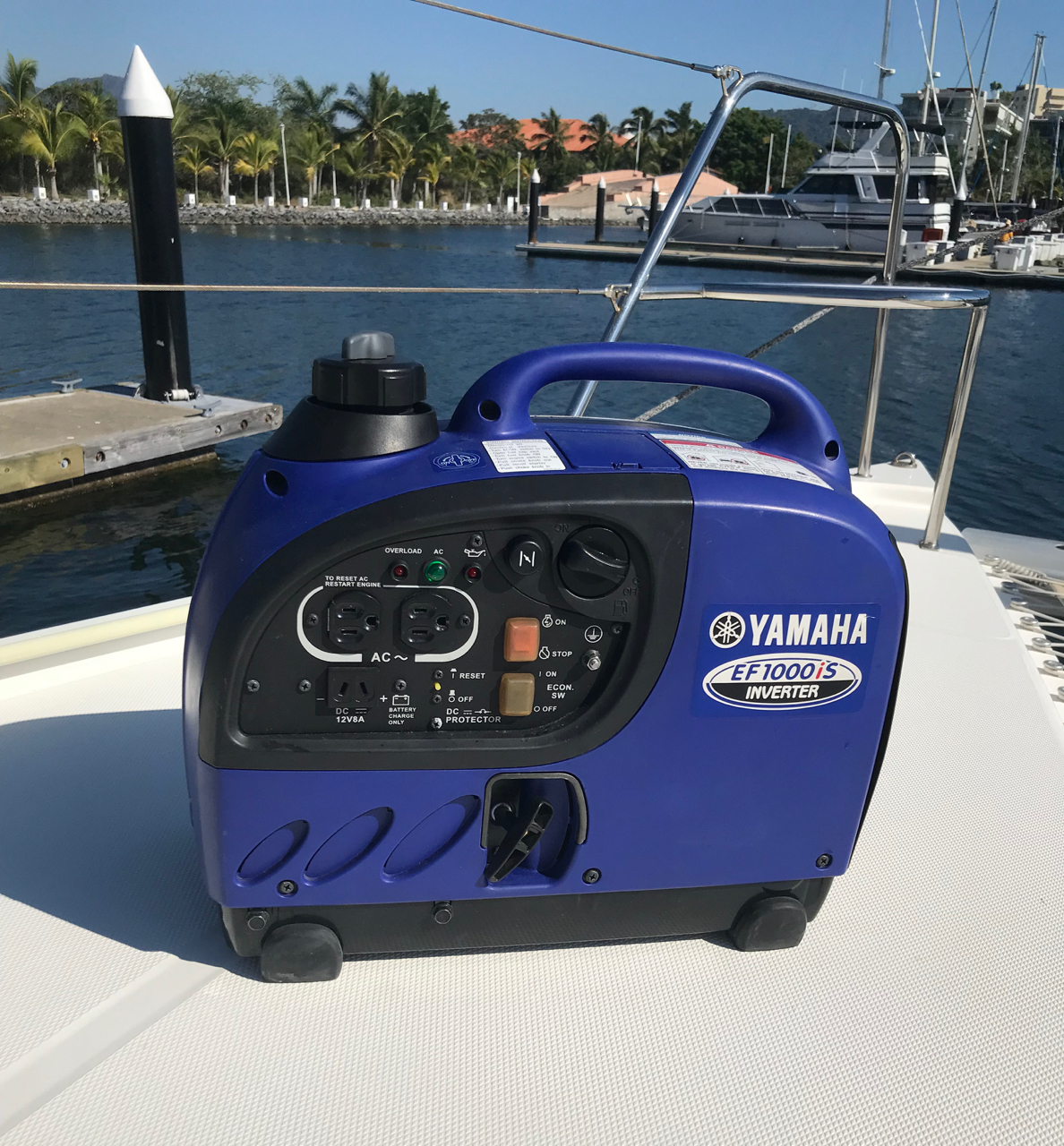
On cloudy days, when our solar panels can't generate enough power, we top off the batteries using a Yamaha portable gas generator. It's rated at a peak output of 1000 watts, but really only puts out a little less than 900 watts continuously. That's plenty to charge the batteries and run the watermaker. It's really quiet under low load, reasonably quiet under high loads. It sips fuel, its 0.66 gallon (2.5 liter) tank lasting for six-plus hours under decent load. It is really small and really light (27 lbs) and stows easily in our bow locker. We've rarely had to use it, but when we have, we've been glad to have it. It is a much more economical way to generate electricity than running one of the diesel engines, both in fuel efficiency and life-cycle costs. It takes advantage of the capabilities of our Victron charger/inverter, which lets us limit the load on the little generator to prevent tripping it's overload switch. My only worries with portable generators are the safety concerns of a floating ground, carbon monoxide and dealing with gasoline fuel. We're just really, really careful about how we hook it up, where we run it and where we store fuel.
13. Advanced Elements Inflatable Kayaks

Our Advanced Elements kayaks are just simply the greatest. They are light, stable, paddle well and about the size of a carry-on suitcase when deflated. We've paddled long distances exploring anchorages, rivers, lakes, estuaries and coastlines. We've taking them out in pretty rough conditions and they are very seaworthy. You can fish from them (be careful with hooks!) and drink shots of tequila in them. They are at least a couple years older than Intermezzo and have been used a lot, but still look great (we keep them out of the sun). They are made in California and the company has been great to work with when we've needed assistance or spare parts. Love these little boats!
12. iPad with Navionics and Raymarine Apps
Intermezzo's iPad is loaded with the Navionics Boating app/charts and Raymarine's RayControl app. The Navionics app and charts give us a redundant means of electronic navigation, independent of our chart plotters. I plan and create routes on the iPad and upload them to the chart plotters wirelessly, which I find much easier than working directly on the chart plotters. They RayControl app lets us operate the boat from inside the salon; we can look at the chart plotter display, monitor radar and control the autopilot. All the apps play well with each other and it's nice to get inside for a break from the helm station every once in a while, particularly on cold night watches.
11. Gori Propellers

I don't think I can justify my investment in Intermezzo's Gori propellers economically, but I sure do like them. They are very expensive to buy and so are spare parts and anodes. But they move the boat well, be it when cruising or maneuvering. They get 8-plus knots out of our 29 hp Yanmars in calm conditions, reverse and stop the boat on a dime. They are ingeniously designed and beautifully made; works of industrial art, really. (When I got them, I felt like displaying them in my house like sculptures was more appropriate then hiding them underwater.) In normal mode, they power the boat well through headwinds and heavy seas. When sailing, they fold to reduce drag, probably adding a half knot to boat speed. But what I like best is the "overdrive' mode, which I believe is unique to Gori props. By unfolding the prop in reverse and keeping it in that configuration going forward, the prop is over-pitched for the engine. In calm and moderate conditions, this allows the engines to drive the boat at the same speed at lower rpms. This saves some fuel, which I appreciate, but what I like best is less and lower-frequency engine noise while in overdrive mode. It makes long periods of motoring much more tolerable, especially when sleeping at night.
I'll continue the countdown of the ten remaining items in our Top 20 gear in Part 2. Meanwhile, you can speculate on what earned the #1 spot.
Thursday, January 17, 2019
Ixtapa: Leg 1 Completed, Goodbye to Pete
Leg 1 of The Voyage was completed yesterday afternoon upon our arrival at Marina Ixtapa. It was a great trip with great crew.
We set sail from Barra de Navidad to Caleta de Campos on Tuesday morning and arrived at Campos on Wednesday around noon. Unfortunately, we had to motor almost the whole way, despite valiant efforts by the captain to catch the fickle winds with the Code 0. I made six furling-unfurling sail entries into the log during my watches, all within an hour of each other. The last furling entry ends with "BAH!", in all caps. In the end I meditated and calmly accepted that I cannot control the wind. And then I opened a beer and drank it to the hum of Intermezzo's economical little Yanmar diesel.
Caleta de Campos turned out to be quite a nice little anchorage. It is somewhat exposed to the ocean swells, so you hear the surf breaking on the beach all the time, sometimes pretty good sized waves, big enough to surf on. Despite the swell, Intermezzo hardly rolled at all at anchor, making for a comfortable stay and night's sleep. There is an attractive little town along and on the hillside on the east side of the cove and steep, burnt orange colored rock cliffs from the center to the west end. A nice sandy beach runs along most the shoreline, the sand also orange-tinted with black highlights. We did a great job landing and launching the dinghy through the light surf for our shore excursions, earning mild respect from the many panga fisherman watching us. We enjoyed a nice meal at one of the rustic beachfront mariscos restaurants; crab, huachinango (Pacific red snapper) and ceviche, washed down with cold beers.
To reach Ixtapa before sunset, we had to leave Caleta de Campos at 04:00 in the dark. We roused ourselves out of bed at 03:30, had a cup of coffee, prepared the boat and weighed anchor, departing right on time.
There was virtually no wind the whole way to Ixtapa and, when there was a little, it was right on the nose. From here to Panama, except for the Golfo de Tehuantepec and the Golfo de Papagayo, the winds are generally light. Intermezzo motored a lot on the previous trips up and down this portion of the coast.
The day spent motoring to Ixtapa was not without excitement, however. We encountered quite a few panga fishermen, open boats about 20 feet long with 60 to 90 hp outboards, manned by two guys. They string out a thin rope to which dozens and dozens of baited hooks are tied, wait around, and then proceed slowly along their line, lifting it out of the water to unhook whatever they catch.
On previous passages, it was pretty easy to avoid these long lines, which can be half a mile long or more. At one end of the line would be a buoy with a black flag. At the other end would be the panga. You just needed to go around the buoy or the panga. This time is was more difficult.
The fishermen were using lines with plastic bottle as floats, the bottles spaced about 50 yards apart. These bottles were often hard to see in the water and the lines were either placed or drifted into confusing curves - crescents, semicircles, spirals. To avoid running over the line and fouling the rudder or propeller was sometimes like trying to figure our way out of a labyrinth.
Some of the fishermen would try to direct us with hand signals. Unfortunately none of us understand Mexican fisherman hand language, which involves hands held in different positions, wagging one way while waving another, which means either go ahead, turn left or turn right. We couldn't tell the difference, so we'd try what seemed right to us. The fisherman either looked at us with a friendly smile, in which case we continued on and they waved goodbye (hand language we did understand), or they got agitated, looked distressed and waved their hands like windmills, in which case we turned different directions until they settled down. Pete was on watch for most of these encounters and he said it was the most stressful part of the trip for him. We only caught one line, for which I jumped into the water to free from the prop. An easy job, no blue spots on my head like Roy's.
We were pretty tired by the time we got the boat tied in its slip, completed our check-in at the marina office and ate dinner. We didn't have keys to the marina showers because they are issued by a different marina office that was closed for the day, so marina residents, neighbors and passersby were treated to the view of nude sailors showering on Intermezzo's stern step. One sailor at a time, not all together. We didn't want to overdo it.
This morning Roy and Pete washed Intermezzo's decks while I straightened up inside. Then it was time for us to say goodbye to Pete who had to fly back to his job as a police officer near Montreal. Snow, cold, brrrrrrrr.....
Pete was great crew, very attentive, practiced good seamanship, always in good humor, even during his short bout of seasickness. He said the best parts of the trip for him were the dolphins, the Code 0 sail and Roy's Frozen Grapes. I enjoyed speaking my bad French with Pete, confounding Roy, who is struggling to learn Spanish. I'm not sure what I'm going to do with the leftover gaily colored Fruit Loops cereal Pete eats for breakfast. But I do know what I'll do with the half-bottle of Appleton rum he left in the locker. We'll miss him. I hope he sails on Intermezzo again.
 |
| Pete ordering bread and pastries (in French) from French Bakery boat in Barra de Navidad. Roy observes. |
 |
| A Blue-Spotted Roy emerges from below Intermezzo after freeing fishing line from prop. |
 |
| The beautiful rugged coastline on the way to Caleta de Campos |
 |
| The small town of Caleta de Campos |
 |
| Caleta de Campos |
Monday, January 14, 2019
En Route to Caleta de Campos
Intermezzo is en route to Caleta de Campos, a small remote anchorage about 115 nm down the coast from Manzanillo.
We weighed anchor in Bahia Tenacatita yesterday around noon for the short sail to Barra de Navidad. When we raised the anchor, we found that the chain had wrapped itself around the shank of the anchor. We tried rotating the anchor to untwist it but the chain was wedged too tight by the anchor's weight pulling down on it. We tried relieving some of the weight by attaching an line and hauling up on it, but that didn't work. I looked at the situation for a moment and then asked Roy, who was at the helm, how deep the water was. He reported 50 feet, so I told him to stop the boat. I dropped the anchor to the bottom and then told Roy to drive in a tight counterclockwise circle. Voila, when we raised the anchor, the chain was unwrapped. I hadn't told Roy about the anchor chain wrap when it occurred and later he asked, "Why did you have me do a donut when we left the anchorage? Is that a tradition or something?"
As we approached Barra de Navidad, I noticed that the hull of the tanker that had wrecked on the cliffs in November 2015 was still there. We first observed this wreck on Intermezzo's first visit to Barra in January 2016. Government authorities were trying to decide the what to do about it then. On Intermezzo's second visit to Barra in March 2017, helicopters were flying workers out to the wreck to clean and dismantle it. I wasn't sure then whether the intent was to cut it up and remove it or just take off the dirty and expensive pieces and leave the rest. Apparently, it was the latter. The superstructure of the ship has been removed, along with the deck piping and appurtenances, leaving just the main hull lying against the cliffs until it rusts away in a couple of centuries. The wreck isn't visible from land, but It spoils the view from the sea of the beautiful natural scenery of the bay, but not too terribly and it's certainly a curiosity.
We dropped anchor in the lagoon of Barra de Navidad around 4 p.m. and hailed a water taxi into town. We saw a sign outside a beachside bar advertising jumbo Margaritas for 50 pesos, an offer we couldn't refuse. The crew apparently is quite sensitive to more than a little tequila. I walked and they staggered slightly as we toured the town. We ended our shore leave with a nice dinner, then it was back to the boat for the rest of the night. For the crew's safety.
This morning, we waited for the French bakery boat to come by so we could buy fresh bread, croissants and pastries Then we weighed anchor and set sail for Caleta de Campos.
Along this section of coast, fishermen in pangas lay a long line with baited hooks between their boat and a flagged buoy. These lines can be a half mile long and need to be avoided. That's usually done pretty easily by spotting the panga and the buoy and steering around the outside of one of them. This afternoon, however, the skipper (me) was puzzled by a line that had multiple floats and we (I) managed to snag the fishing line, first with the rudder, then with our own fishing tackle trailing behind, then with the other rudder and then wrapping one of our fishing lines around our propeller. Mind you, this was all done with great care and precision.
Roy immediately offered to dive below the boat to free the fisherman's line from our rudder and our fishing line from the prop. I decided I'd tell him about sharks being attracted to the fish caught on the long baited lines after he had completed his work so that he wouldn't lose focus. He made quick work of the job while accenting the top of his head with beautiful bright blue patches of bottom paint. Pete started to tell Roy about his blue spotted head but I shushed him up so that I could get a picture. Pete thinks that I would never have told Roy, but that's not true. I wouldn't let him spend more than an hour ashore in public looking like that.
We're sailing along gently tonight under the Code 0 after motoring most of the day against light headwinds. We're all looking forward to exploring Caleta de Campos, our last anchorage before we end the journey in Ixtapa.
Saturday, January 12, 2019
Tenacatita: Anchored at 'O Dark Thirty
We anchored in Bahía Tenacatita at 05:30 this morning, about an hour before sunrise.
We had sailed all day yesterday until we reached Chamela at about 21:00 when the wind dropped. We considered "bobbing around" (Roy's term) and wait for the wind to pick up, but the motion of the boat lying beam-to to the swells was not very comfortable for off-watch sleeping. I considered anchoring by moonlight in Bahía Chamela for the night, but decided against it. I hadn't studied the anchorage well enough and wanted to spend the next day in Tenacatita, about 30 nm further down the coast.
It was awkward timing. If we motored at standard cruising speed we would arrive at 03:00. The moon set around midnight and if we weren't comfortable with anchoring in darkness we would have to bob around for quite a while until sunrise. So, I decided to motor at minimum speed, which would get us to the entry to the Tenacatita around 04:30. That way, if we aborted anchoring, we'd only have to bob around for an hour and half to wait for dawn's light.
We entered the anchorage cautiously, navigating mostly by radar and chart plotter as it was very dark and difficult to make out the rocky shoreline. As we inched our way into the anchorage, there was enough light behind us from the nearby town of La Manzanilla and a beach resort for us to make out the shore and the other boats in the anchorage, most of which were showing there anchor lights.
We made quick work of anchoring and Roy, who had been off watch in a deep sleep, went right back to his bunk. Pete and I enjoyed mini "sun-upper" glasses of rum to celebrate our arrival and relax as the sky lightened to an orange-pink, then turned in to catch a few more hours sleep.
I got up early, swam from the boat to the beach and did some yoga, observed by an egret who was fishing in the shallow surf in front of me. The rest of the crew roused themselves a bit later to begin enjoying our beautiful surroundings. Intermezzo previously visited Tenacatita in January 2016 with friends Marc and Marcy on board. On that visit, we took an adventurous trip through the mangroves, and discovered we were the first yatistas to have made it through the estuary since damage from Hurricane Patricia the previous November.
This visit was far more relaxed. We took the dinghy to a nearby beach restaurant and enjoyed some micheladas (beer and clamato juice with chili and salt around the rim of the glass) and shared the local seafood specialty, "rolls de mar", a filet of fish stuffed with shrimp, wrapped in bacon and smothered in a creamy almond sauce.
This morning we had a meeting onboard and the crew decided they would like to push on tomorrow to visit Barra de Navidad. The captain granted their request as a reward for their bravery and good behavior at sea. We set sail for there tomorrow morning.
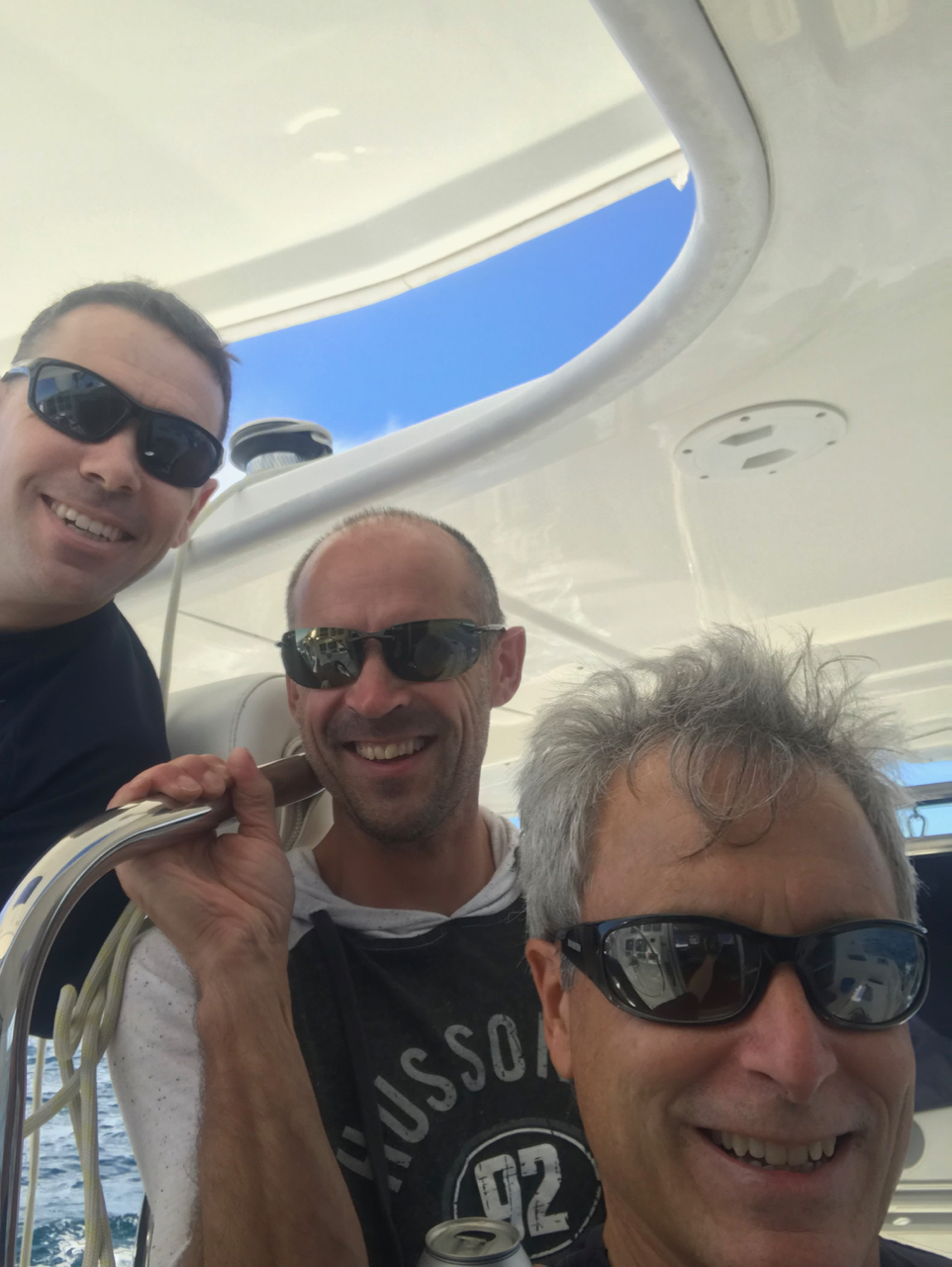 |
| Pete, Roy and me, Captain and Crew of Intermezzo for Leg 1 of the Voyage |
 |
| Roy filleting the dorado we caught on the way to Tenacatita. |
Friday, January 11, 2019
En Route to Tenacatita: Fish On, Night Arrival
We had another great day of sailing in beautiful conditions under the Code 0 sail, which the crew now loves as much as I do.
We caught a nice 12+ pound dorado (mahi mahi) at mid-day on the new lure I got for Christmas. It was a beautiful fish, blue, green with a bright yellow tail. I always feel a bit sad when I kill a fish like that and all the color drains from it. It's like you are watching its life fade away, a beautiful creature never to swim in the sea again. It makes me want to be a vegetarian and leave the fish alone. But not today. We had fish tacos for dinner and we saved the best fillets to grill tomorrow.
We are about six hours away from the anchorage at Bahia Tentacatita, which means we'll arrive just after midnight. I normally avoid entering anchorages in the dark, but I've been to this one before and its big. We'll find a temporary spot to anchor in safe water, away from other boats for the rest of the night and then move to a better spot if we want to in the morning. I'm feeling an appropriate level of cautious apprehension; I'm going to be really careful, go slow and if I don't like it, head back out and heave-to offshore for the rest of the night.
Subscribe to:
Posts (Atom)