Tuesday, January 8, 2019

Departed La Paz, Starting Leg 1 of The Voyage

We left La Paz around 10:00 a.m. this morning after preparing the boat, checking out of the marina and topping off the fuel tanks and jugs. Roy, Pete and I were pretty excited and happy to be starting the journey. I felt a little bittersweet sadness saying goodbye to La Paz, a town that I have called a second home for almost two years.

We're headed for Tenacatita, a small bay about 120 miles south of Puerto Vallarta. It should take us about three days sailing to get there.

We motored out of the Bahia de La Paz and through the San Lorenzo channel. Once we were out of the lee of Isla Espiritu Santos the wind picked up and we hoisted the main and jib. As we shaped our course towards the southeast and were sailing more downwind, we dropped dropped main, rolled up the jib and unfurled my favorite sail, the Code 0. Soon the wind piped up and we enjoyed loping along at 7-8 knots, surfing steep five foot seas. The wind kept building and I 22 knot true, I called for the Code 0 to be rolled up and the jib deployed. Now we're sailing pleasantly along at 5-6 knots almost dead downwind in somewhat confused seas.

Roy and Pete have taken well to Intermezzo and I'm quickly bringing them up to speed on sailing the boat. We're a double-handed watch schedule, with Roy and Pete standing watches and me on continual standby, keeping tabs on things and ready to answer questions or provide assistance whenever needed.

I'm cooking dinners each evening at the 18:00 change of watch. Tonight we had a shrimp Thai curry. Pete was a little seasick so only got half rations.

The weather has been beautiful. Slightly cloudy skies, breezy, cool. There's a sliver of moon out.

It's good to be on the water again and I'm grateful that our first day of sailing has been so enjoyable.

Sunday, January 6, 2019

George, Again

LA PAZ, MEXICO

Yesterday was a good day.

I finally found the spare primary fuel filters I have been trying to purchase since November. Intermezzo has Racor fuel filter water separators to protect the engines from diesel fuel contaminants.      Although we have yet to have it happen on Intermezzo, it is not uncommon on boats for the filter elements get clogged by gunk stirred up in the fuel tanks during heavy weather, from sucking fuel from the bottom of near-empty tanks, or from dirty fuel. If a filter gets clogged, the engine won't run, so it's important to have spare filter elements on board. We were down to just one spare on Intermezzo.

Replacement Racor filter elements are usually readily available. However, last Fall, the manufacturer moved its factory across the country and apparently had a lot of trouble re-starting its operations for quite some time. I looked everywhere in the U.S. for filters for two months and came up empty handed.  I returned to Mexico hoping that I might find some here in La Paz.

Yesterday morning I tuned into the daily La Paz cruiser's net on the VHF radio and when the "local assistance" segment came up, I asked if anyone could help me source the Racor filters that I needed. I was delighted when George from s/v Thalia responded with some recommendations. Delighted because George is one of my favorite people that I've met sailing since leaving on this extended voyage. Those of you who have been following this blog may remember him.

I first met George briefly in Puerto Chiapas while clearing out of Mexico to head south in March 2016. The marina manager helps cruisers clear in and out of immigration, customs and the Port Captain by driving them around in the proper sequence in his truck. George and his girlfriend rode in the truck with me and a couple of other sailors as we made the rounds. I didn't talk to him much at the time, but I remember thinking looked like an interesting character.

After clearing out of Mexico, our next port was Bahia del Sol in El Salvador. It turns out is was Georg'e next port, too.  To make a long story short, I spent much more time in Bahia del Sol than I wanted to and during that time got to know George pretty well over quite a few beers.  He watched over Intermezzo while Renee and I took a sightseeing trip inland, helped me when I beached Intermezzo to work on the props and sail-drives and was a good friend when Renee had to leave suddenly when her Mom had a stroke. When I said goodbye to George when I finally left Bahia del Sol on my own for Nicaragua, I figured I might stay in touch via email but that I'd never see him again.

What a pleasant surprise it was one morning seven months later in October 2016 when, in the isolated anchorage of Bahia Ballena in Costa Rica, I see George rowing his dinghy towards Intermezzo. Renee had returned and we enjoyed a dinner on board Thalia, featuring George's homemade pizza and his potent "rum and yellow shit" cocktails. When we said goodbye again I, I figured it was a lucky coincidence to have met up with George again, but very unlikely to ever happen again.

So, last November as I was eating lunch in the cafe at Marina La Paz, you can imagine my surprise when I looked out the window down onto the dinghy dock immediately below and there's George, not  10 feet away from me getting out of his dinghy! I was truly amazed. We had a brief conversation and he invited me to dinner on Thalia. I got busy with launching Intermezzo and boat projects and wasn't able to make the dinner.  I figured that George would be sailing on and that was the last time I'd see him.

By now it's clear that my figuring regarding George is wrong. It will never be the last time I see him. He will pop up again, as he did yesterday on the radio.

George's recommendations for where to find the Racor filters turned out to be spot on. Based on conversations with local boat maintenance people, I believe I purchased five of the last two dozen Racor filters of this type for sale in La Paz. It is a big relief to have enough spares on board for Intermezzo's upcoming journey.

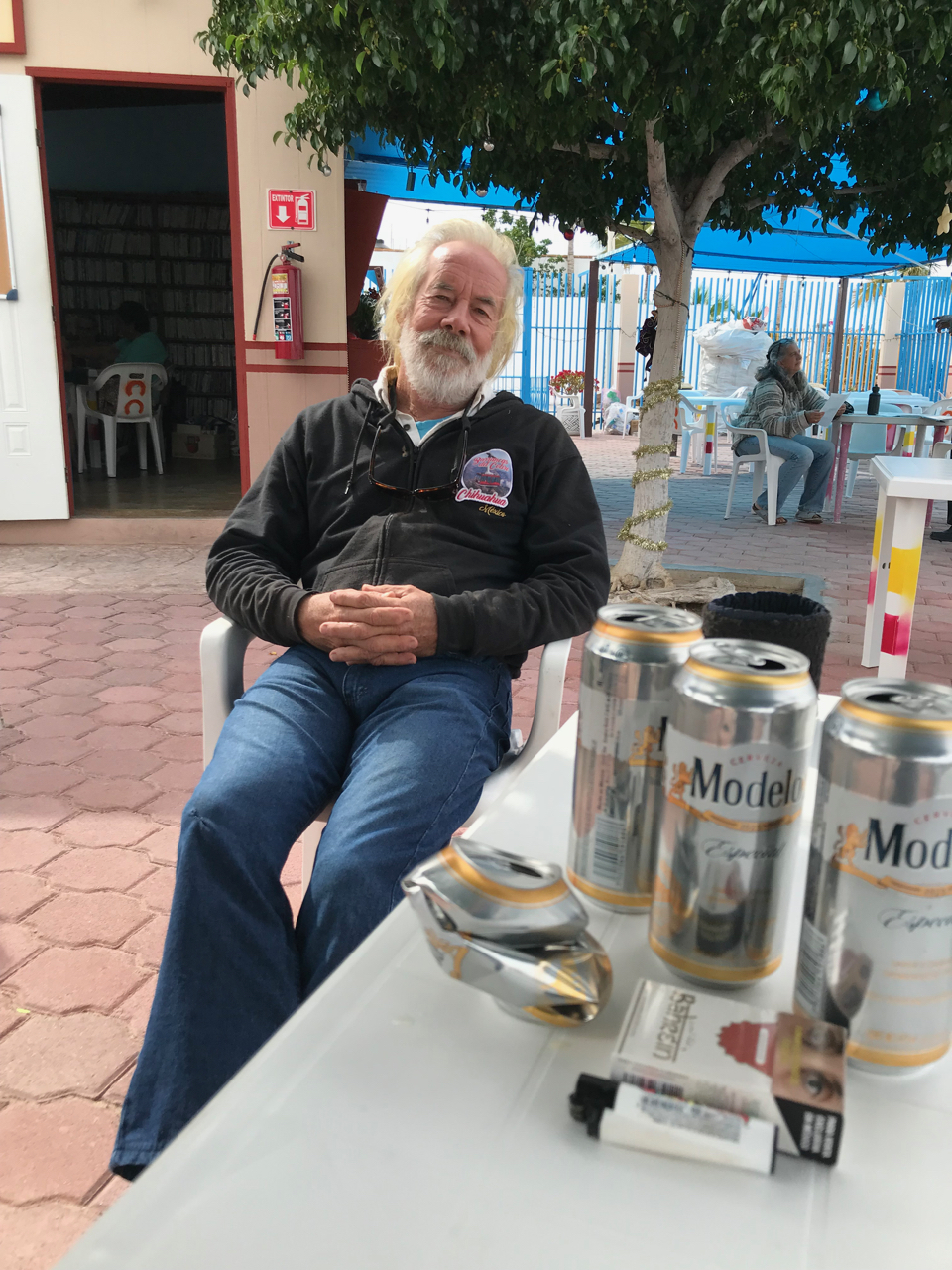
After buying the filters, I met up with George at Marina La Paz and had a beer with him. I enjoyed his company, but was saddened to learn that he recently discovered a serious health problem.  It's still being diagnosed, but it is potentially life threatening. As we talked about it, I couldn't help but feel some optimism for him. I told him I'd always been wrong when I've said goodbye to him, thinking it will be the last time I'll see him. I figure he'll get through this and I'll see him again, somewhere unexpected. I gave him a wholehearted hug as I said goodbye, sincerely wishing him the best and hoping our paths cross again.

In addition to finding my Racor filters and meeting up with George, yesterday was a good day because Intermezzo's crew, Roy and Pete joined the boat.  More about them in my next post.

And as an added bonus, Sir Geoffrey The Heron, paid us a brief visit. Sir Geoffrey fished from, slept on and shat upon Intermezzo on-and-off for a few months last year. He's a very aristocratic chap who walks up and down the dock as if he owns it. We became well enough acquainted that he would allow me sit quietly in close proximity while he fished off Intermezzo's stern, though he remained very aloof to a commoner like me.

George, again.

A few of the last Racor filters in La Paz

Sir George, gracing the dock at Marina Palmira with his presence


Friday, January 4, 2019

The Voyage

LA PAZ, MEXICO

Today I flew back to La Paz to join Intermezzo and prepare to resume The Voyage to the US eastern seaboard.  I summarized the multi-leg plan for The Voyage in a previous blog promising to provide more details. Here they are, a synopsis of Intermezzo’s planned itinerary over the upcoming months:

Leg 1: La Paz to Ixtapa
January

Originally I planned on sailing from La Paz to Huatulco, the jumping off port for crossing the Golfo de Tehauntepec, a 1,000 nm non-stop passage. However, tropical storm Vincente silted in the marina in Huatulco, which won’t be dredged until the end of February at the earliest. So we’re sailing to Ixtapa instead, about 350 nm less distance south which will take us about six days. Ixtapa has a good marina and is right next door to Bahia Zihuatanejo, a pretty spot popular with cruisers. I’ll leave the boat there for the month of February, which not a good month for crossing the notorious Tehauntepec.

Leg 2: Ixtapa to Puerto Chiapas
March

The worst of the high winds blowing overland from the Gulf of Mexico into the Tehauntepec will be over in March but we may need to still wait a few days in Huatulco to catch a good weather window for the passage. We’ll cross the Tehauantepec (my third time) with “one foot on the beach” to avoid any big seas the get whipped up by the frequent high winds. Huatulco has several pretty little bays in which to anchor if the marina there is still silted up. The 600 nm passage from Ixtapa to Puerto Chiapas should take about six days, but we’ll need to allow for a few more days to wait for our weather window. I plan on hauling out Intermezzo in Puerto Chiapas for a bottom paint job and some minor fiberglass repairs done, a last chance for low-cost, decent quality work and powerful Mexican anti-fouling paint (don’t ask what’s in it).

Leg 3: Puerto Chiapas to The Panama Canal
April

With a clean, fresh bottom, Intermezzo will sail on to the Caribbean end of the Panama Canal. This is planned as a non-stop 1,000 nm passage to the Pacific entrance of the canal, though we might need to duck into Golfito, Costa Rica to pick up fuel if winds are light or adverse to sailing. We should be able to complete the main passage within two weeks. We might need to wait a week to clear in and process paperwork for our canal transit, which normally takes two days going south to north. During that wait, crew will be encouraged to serve as line handlers on other boats transiting the canal to gain knowledge for our own transit. Intermezzo will then wait out the end of the seasonal tradewinds in Shelter Bay Marina before heading north on the next leg of the voyage.

Leg 4: Panama to Isla Mujeres
May

We’ll sail from Panama to Isla Mujeres, Mexico, an island lying about 6 miles off the coast from Cancun, a total distance of about 1,000 nm. We’ll  make two brief stops along the way, the first at the Columbian island of Providencia and the second at the Cayman Islands. Hopefully, prevailing winds will have shifted eastward by the time we make this passage, but we could well be sailing and/or motoring “uphill” a good portion of the trip, not the most pleasant sailing experience on a cruising catamaran. This will mostly offshore sailing and in new territory for me, which will add to the adventure. I’m hoping to get a day of SCUBA diving in during out stop in the Caymans.

Leg 5: Isla Mujeres to Florida
June

This passage is 400 nm bash across the Gulf of Mexico from Isla Mujeres and Florida (port TBD) to clear into the USA. Winds and seas will likely be against us, so we will likely be motor-sailing or motoring most of the way.  But maybe we’ll get lucky and catch some favorable land breezes off Cuba. If paperwork and insurance for the boat can be arranged, we may stop in Cuba for a brief rest and visit.

Leg 6: Florida to Long Island, NY
Summer-Fall

This leg will be a multi-stop passage mostly up the Intercoastal Waterway from Florida to the Great South Bay of Long Island, NY, the ultimate destination of The Voyage, the waters on which my father and I learned to sail together, one of the most formative experiences of my life. The details and schedule for this passage are yet to be determined. I expect that this will be mostly daytime sailing/motoring with stops most nights along the way.

I’m feeling very excited about resuming this voyage, confidence in myself, the boat and the sailing mixed with a bit of healthy apprehension over the uncertainties of new crew, logistics of a canal transit, and the more dynamic weather and waters of the Caribbean, Gulf of Mexico and Atlantic. I'm also feeling a little sadness over leaving those I love behind on shore.  I am looking forward to keeping the boat moving while I’m on it, rather than living on it while stationery in an anchorage or a marina. I’m curious about how it will be back on land during my breaks from the sailing, how I’ll handle the to and fro.  I have a strong feeling of purpose for this voyage, though I have yet to articulate it beyond myself in language…an upcoming post for my personal blog, I’m thinking.

This Voyage is a very, very big deal for me.  It’s clearly part of a Path that lies as memories behind me in the past and extends into discoveries ahead of me into the future. Intermezzo on the sea is my place to be present in the here and now, open to experiencing and accepting what truly is.


(Please note that I will be posting to this blog via satellite email while underway, which means that I can't provide notifications of new posts via Facebook. If you want to keep current, the best way is to Follow by Email by entering your email address into the box on the right.)


Tuesday, December 4, 2018

Rudder Leak Fixed

I returned to Intermezzo after the Thanksgiving holidays and made a permanent fix to the port rudder leak that I discovered and temporarily repaired just before I left. I discovered the temporary repair worked great, as the engine compartment was bone dry when I returned.

I figured I should do the repair for both rudders, which turned out to be a good move because, on close inspection, the starboard rudder penetration was seeping moisture, too. I wouldn't call it a leak, but I definitely didn't want it to get worse.

The first step was to lift the port stern out of the water a bit to relieve water pressure on the leaking area. Given the effectiveness of the temporary repair, this was probably not required, but I was interested in seeing what I could do by ballasting the starboard bow. I put all the anchor chain, extra anchor rodes, tools and spares out of the storage area beneath the port stern berth, inflatable kayaks, and the Code 0 sail on the bow, emptied the port water tank and filled the starboard water tank.  I'd estimate about 1,500 pounds of ballast in total, which lifted the port stern up about five inches. That was enough to just about eliminate any water pressure at the leak location. If I wanted to raise it more, I would have pumped diesel from the port fuel tank into jerry cans and put them on the bow. I'll bet if I did that the rudder hull penetration would be completely out of the water.

Next I cleaned the aluminum rudder tubes, first with sandpaper then wiped down with solvent. I decided to keep the fillet I built up using SplashZone epoxy for the temporary repair rather than remove it, so I just sanded it smooth and cleaned it up. For the starboard rudder, I built up a new fillet using SpashZone, but I'd wished I'd used an epoxy putty like, JB WaterWeld as the SplashZone is really messy to work with.

Then I fiberglassed the joint between the two tubes, using woven fiberglass tape and  G/Flex epoxy, which works in damp locations (even underwater) and for bonding to metal surfaces. I used four overlapping layers of tape, starting at 1-inch wide and stepping up to 4-inches in one inch increments. I trimmed the bottom and top of each piece of tape to different lengths to accommodate  the two different diameter tubes, tapering in the middle. It was a little tricky working in the cramped engine compartment, but I managed to do an acceptable job without getting epoxy all over the place or all over me.

The rudder leak is now fixed. For good, I figure.

Ballast on the starboard bow- 300 ft of 3/8" anchor chain is buried under there, too!

Port stern lifted about 5 inches by ballast on starboard bow.

The leaking rudder penetration- before repair
SplashZone epoxy fillet - retained from temporary repair

Four layers of fiberglass tape, cut to overlap and fit different diameter rudder tubes.

The finished permanent repair.


Thursday, November 22, 2018

Leak, Crew, Potential Re-routing

PENNGROVE, CALIFORNIA

I left Intermezzo in La Paz to enjoy the Thanksgiving holiday in California.

Just before I left I had to deal with a very small leak coming from the tube that penetrates the hull for the port rudder. The sealant in the annular space between this tube and the rudder tube has failed and water was steadily trickling into the engine compartment ever since launching the boat a few weeks ago. The sump below the engine was full of water and was starting to spill over into the bilge pump well.

It's not a dangerous leak, but it needs to be fixed.

I didn't have time to do a permanent repair before I had to catch my flight but I did a good temporary one.  I built up a fillet with Splash Zone waterproof epoxy between the two tubes and then wrapped it with self-fusing silicon X-Treme Tape.  The slowed the trickle to just a drip.  The Splash Zone wasn't really the right material to use for this repair; I thought it would be a stiff enough paste to stop the leak but the steady trickle of water was enough to thin and weaken it. Now I have rock-hard cured epoxy to deal with when I do the permanent repair. I should have used butyl tape to make the temporary fillet; that might have actually stopped the leak, too.  However, I am very impressed by the X-Treme Tape. It was really easy to work with and made an effective temporary repair that can be easily removed.

When I get back to the boat, I'm going to ballast the opposite bow of the boat to raise the port stern and get rudder penetration out of the water. Then I'll fiberglass the joint between the tubes to stop the leak completely and permanently. I'll fiberglass the starboard rudder penetration too, as it shows signs of leaking in the past.

The other news is that a third crew member has signed on for Leg 1 of The Voyage. Pierre-Luc ("Pete") is a police officer from Quebec and has some decent experience sailing on catamarans including a delivery from Miami to Belize which included some pretty heavy weather. I think Pete, Roy and I will make for a very capable and compatible crew.

We may need to change our destination for Leg 1. Marina Chahue in Huatulco is currently closed due to silting from Tropical Storm Vincente. The harbormaster says they are waiting for dredging equipment to arrive but has no idea when the marina will reopen. This is an important marina for southbound sailors as it is the place to wait for a weather window to cross the Golfo de Tehuantepec. The next closest port to the north is Acapulco.  I didn't like Acapulco much when we stopped there in February 2016; beautiful a place as it is, it seemed like a tired and worn out city. So, if Chahue doesn't reopen in time for us to sail to Huatulco, we'll probably end Leg 1 in Ixtapa, next door to Zihuatanejo. That will add quite a few miles to Leg 2 and make it a bit trickier to time the Tehauntepec weather window, but won't be too big a deal.

Intermezzo's weeping rudder penetration

Wednesday, November 14, 2018

Roy Saves the Day! (With Help from Gilles)

It’s been a very productive time since launching Intermezzo on November 2.

First, the boat needed a good scrubbing to remove all the dirty footprints of the boatyard guys who helped launch us. I made my first trip to the Saturday street market to pick up fresh food with a stop at my favorite grocery store, Aramburro, for basic necessities, including beer, wine, and rum.

Next I bent on the main sail and stack pack. This is a tough job to do solo because the sail is heavy and unwieldy. It took a few grunts and groans, but I managed to do a full test hoist to the top of the mast and then flake the sail neatly in the stack pack. I finally got the lazy jacks adjusted so they work and look better, too.

Miscellaneous jobs, unpacking and organization took up the next couple of days, but by Wednesday I was ready to tackle the biggest job on the list; repairing the jib furler.  The furler had been getting increasingly hard to turn over the past year, making it difficult to furl and unfurl the jib. Now I could hardly turn the furling drum at all.

I had contacted the US distributed of the Z-Spar furler, US Spars, to describe the problem and ask them for advice on how to repair. Their technical advisor, Matthias, told me that my model of furler has stainless steel bearings and they needed to be replaced. So I ordered a pair ($149 plus shipping!) and brought them with me to La Paz.

I had a diagram of the main furler components and instructions on how to install and remove it, but no internal parts diagram and Matthias could not provide one, only a verbal recollection from when he used to repair them back before the furler design changed in 2012.  So I figured I would have to proceed carefully and do exploratory surgery.

The first step was to remove the furler from the forestay. I checked the tension on the forestay and it seemed pretty loose to me, so I thought I would be able to remove the rigging pin without having to loosen the shrouds, the turnbuckles of which I new would take a lot to get to turn after several years of neglect on my part. I gave the rigging pin a tap and it seemed to move pretty easily, so far so good. So I used my socket extension to drive the pin out. It got a little harder to get the pin to move, but I kept tapping. Big mistake. The pin shot out of the clevis, fortunately landing on the trampoline instead of in the water, to be replaced by my socket extension, now jammed tightly in the hole of the clevis. Shit.

That was stupid of me. I totally underestimated the tension on the forestay and, of course, it needs be pretty tight to support the mast. I knew that subconsciously, I guess I just went into denial so I wouldn’t have to deal with loosening the shrouds. Lazy and stupid of me.

I got some penetrating oil out, soaked the shroud turnbuckle and started going at them with the biggest wrenches and screwdrivers I had on board. No way was I going to get them to turn just doing that. I sunk into a feeling of slight despair, what had I done? I made Intermezzo un-sailable. How was I going to get myself out of this self-made predicament?

Just then, guess who appears on the dock with a bag of tools? Roy! He had emailed my the night before to tell me that he was coming to help work on the boat, but I hadn’t received his message. So, to me, he showed up out of the blue, just at the right time. I explained to him in a forlorn tone the jam I had gotten myself into.  He took it all in stride and said, encouragingly, “Well, you know what they say. No such things as can’t. It’s just how.”

Roy has worked just about every job there is on oil rigs and oil wells. I figure the furler and stuck turnbuckles looked like toys to him, compared to the scale of rigging he is used to working with. He took a look at the turnbuckles and then set out for the hardware store to buy a couple of tire bars to get more leverage on them

While Roy was away, I called my friend and rigger, Gilles (GC Rigging and Composites), to ask his advice on how to loosen stubborn rigging screws. He told me to use penetrating oil, apply heat with a heat gun and just start working them back in forth, bit by bit. When Roy returned, we did just that, and after few hours of hard, sweaty, oily work, we got the turnbuckles freed up and my socket extension extracted from the rig.  Hurrah!

Roy and I then set to repairing the furler. The ball bearings were not only devoid of any lubricant, they were jammed up by rust from failed shaft seals. The shaft seals had carbon (not stainless) steel springs which had completely rusted away in the salt water environment, depositing their remains in the bearings. The whole bearing assembly is a terrible design, the bearings inaccessible to lubricate and dissimilar materials causing galvanic corrosion all around them. A rusted mess.

It was sunset when we finished cleaning the furler up and we decided to call it quits for the day.  We cracked open cold beers and I bought Roy a well-earned dinner at Vrentino’s, one of my favorite La Paz restaurants. 

The next morning we started reassembling the furler. We didn’t have replacement shaft seals but decided it was better to just install the new bearings without them, as it would make it easier to flush them with fresh water. By late morning, we had the furler repaired and back on the forestay, the shroud turnbuckles turning smoothly to tighten the rig back up.

That difficult job done, Roy took the briefest of a pause and then asked “What’s next?” I stood there and looked at him for a few seconds. On my own, I probably would have called it a day, pleased to get the job done before the heat of the afternoon. But looking at Roy, eager to do more, that was out of the question.

So, we ended up stripping and cleaning all five winches on board, a job that is supposed to be done annually, but which I had waited over five years to do. The guts of all the winches were pretty clean and well-lubricated, confirming my conclusion that annual maintenance is excessive. The benefit of taking the winches apart is more to inspect them, in my opinion. I think from now on I’ll pull the drums off annually and only strip, clean and lubricate if things look funky.

Roy not only saved my bacon with the jib furler, he proved to me that he is a very capable guy, both in skill and attitude, with a calm demeanor and sense of humor. We got along really well.  He’s volunteered for the entire Voyage and I’m very optimistic that he will be a great crew member and that we’ll become good friends.

In gratitude for his help and to check his skills and abilities on the water, I invited Roy to bring his two daughters vacationing from cold Edmonton on an overnight sailing trip, which he enthusiastically accepted. 

That’s what we’re doing now. Intemezzo is anchored in Caleta Lobos, one of my favorite little coves just north of La Paz,  and Roy, Rylee and Keely are swimming around the boat together enjoying themselves in the warm blue water.

Yesterday’s sail here was in windy (>20 knot) conditions with steep 1 meter chop, beating upwind. Although he has very little sailing experience, Roy did great as we worked through raising sails, reefing, tacking and anchoring. He’ll be great crew.  I’m feeling very fortunate and grateful for our paths to have crossed when they have. Serendipity, I guess. 

Tomorrow I fly back to California to catch up with my daughter Hannah at the tail end of her visit there and to cook a Thanksgiving dinner, leaving Intermezzo at rest at berth in Marina Palmira.

The furler raised, exposing the clevis and pin at the end of the forestay. Just before I messed up.

Saturday, November 3, 2018

Intermezzo Launched!

We successfully launched Intermezzo yesterday and motored up the Canal de La Paz to Marina Palmira, Intermezzo’s home port for the next couple of months. I appreciated assistance from Roy, a potential crew member for The Voyage who drove up from Cabo to help and get acquainted with me and the boat.

The launch went well as I had arranged with a nearby boat yard to have several helpers on the boat in addition to Roy to help guide Intermezzo into the travelift slipway, which is only a couple of feet wider than Intermezzo’s maximum beam (width). It was high tide, conditions were calm and what little wind there was, was on the nose. It all made for an easy launch.

The only minor hiccup was the port engine not turning over when the boat got in the water. I had checked both starting batteries the day before and they had discharged quite a bit during six months of storage. I connected them to the house bank to charge them via the solar panels for the whole day and they both checked out with over 12 volts by evening.  I was pretty confident that they would have enough juice to start the engines, but just to be sure I didn’t end up in an awkward situation in the slipway, I bought a small jump starter battery pack at the nearby Autozone shop. When it came time to start the engines, the starboard engine started up after a few revolutions but the port engine just went “click”. No worries, though. Roy jumped into the engine compartment, quickly connected the jump start pack and a few seconds later, the port engine was chugging along nicely.  I highly recommend having one of these jump start packs on board if your house batteries are too far away from the starting batteries to use jumper cables, as they are on Intermezzo.

The port battery has been worrying me , seeming to lack cranking power compared to the starboard battery for the past year. I’ll bring both batteries into the shop for testing and maybe they can be renewed by applying an equalizing charge, a high voltage charging that gets the sulfates off the lead mats. I hope that works rather than replacing the batteries here because I am a devout believer in Lifeline batteries, a brand that is difficult to get in Mexico and expensive if you can find them.

It was nice motoring to Marina Palmira with Roy on beautiful sunny day with a gentle breeze. Roy is enthusiastic, attentive, fit and has a solid set of skills from his diverse work experience in the oil industry, but he hasn’t sailed much. I used our short trip to acquaint him with aids to navigation (buoys) and rules of the road. I explained that even if a stand on vessel has right of way over a burdened vessel, the stand on vessel must take action to avoid collision if necessary. Right after explaining this, I had to speed Intermezzo up to avoid a collision with a panga to our port (the burdened vessel) commanded by a solo fisherman who was messing with his fishing gear instead of steering his boat. I told Roy, “See, that was just like a power boater from Alberta. You can’t trust them.” Roy is Canadian, from near Edmonton.

It felt good to sleep in my berth on Intermezzo last night. I still have to unpack a bunch of stuff and put things in their proper place, but the boat feels like home again.  I went shopping at the Saturday street market today and filled the fridge and larder with fresh vegetables, staple ingredients for meals, a few bottles of wine and a bottle of rum.

Now to tackle the long list of pre-Voyage projects.

Charging the starting batteries with solar panels via the house bank

Intermezzo in slung in the travelift, on the way to being splashed
The little ump starter battery pack that saved the day


My old friend Jeffery on the dock.
No sign of his cousin, Sir Geoffrey yet.


The pre-Voyage task list.
I squeezed it onto one page.